The Tatkal Gamble: How India Sells 500 Train Seats to 2 Million People Without a Single Mistake

Understanding the Problem: The Alarm That 2 Million People Set#
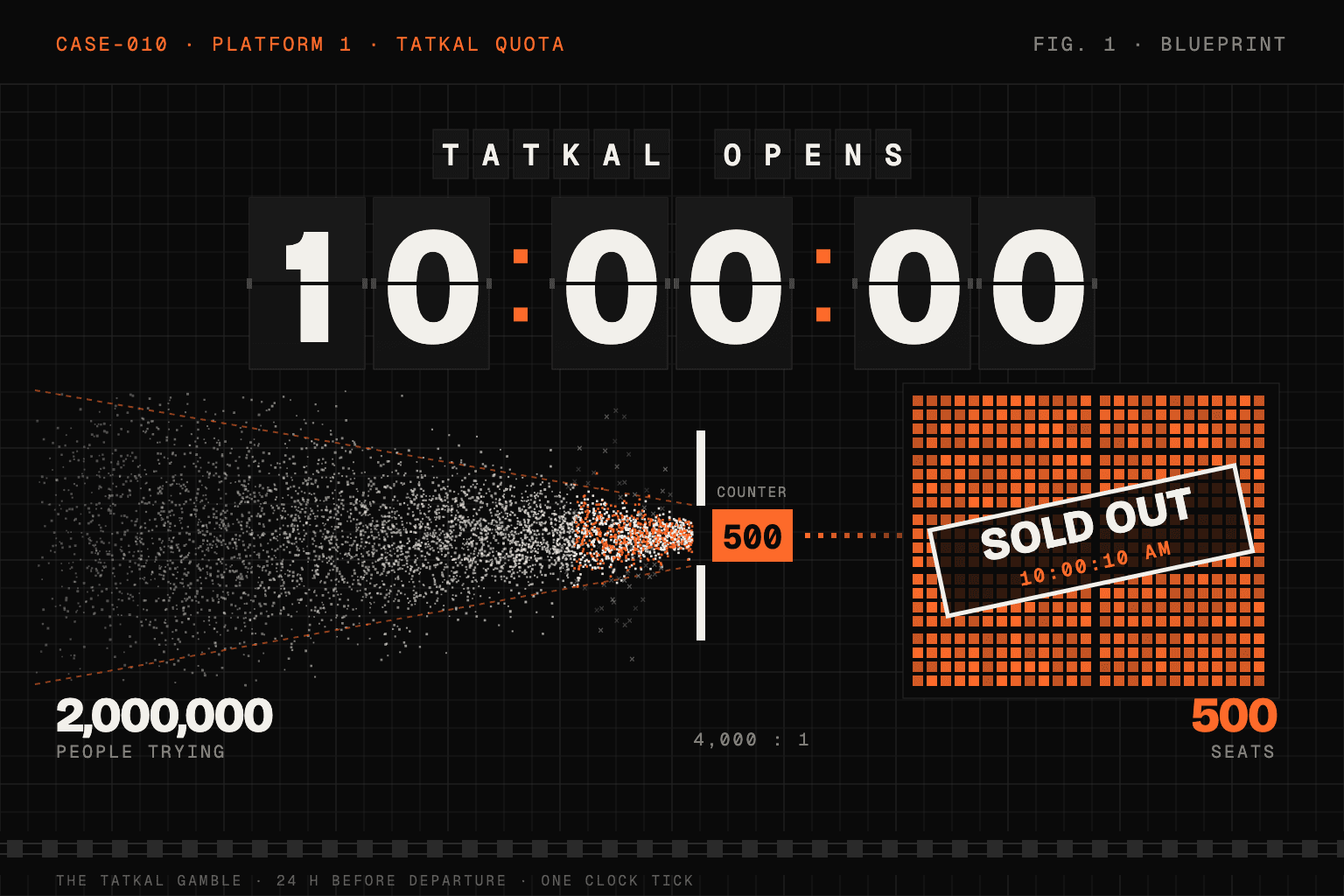
Ananya's father called last night. Her grandmother is unwell in Lucknow, and the family needs her home by tomorrow evening. There's exactly one train that works — the one everyone in North India seems to want. Ananya sets two alarms: one for 9:55 AM, and one in her head that's been ticking since the phone call ended.
At 9:59 AM, she's not alone. Across the country, in college hostels, office cubicles, kitchens, and cyber cafés, roughly two million other people are opening the same app, refreshing the same page, staring at the same clock. They're all trying to do the exact same thing: grab one of a Tatkal quota that, on a popular train, might hold as few as 400 to 600 seats.
At 10:00:00 AM, the clock ticks over. And in the time it takes you to read this sentence, most of those two million chances are already gone.
The Numbers That Make This Insane:
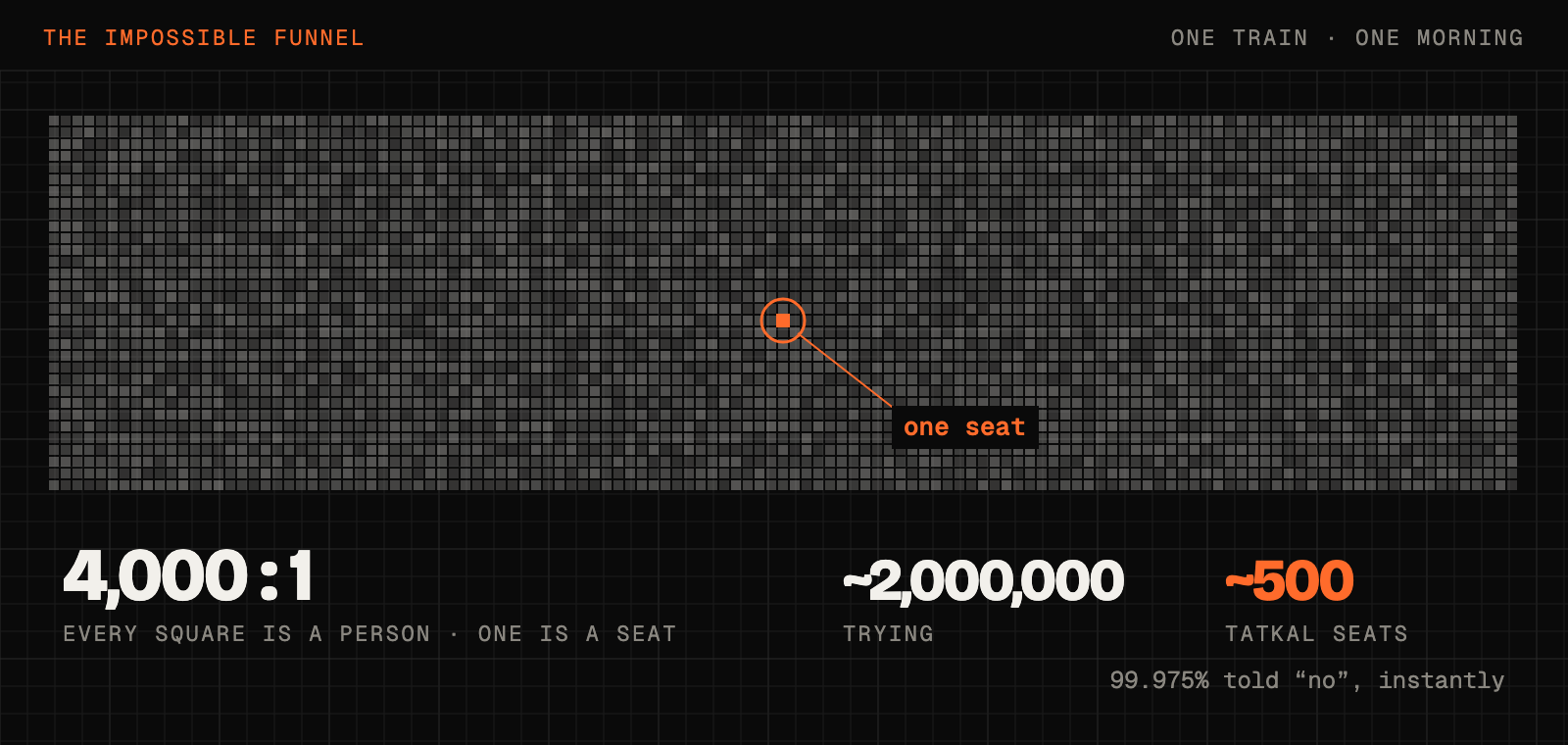
- ~2,000,000 people trying to book the same train, the same day
- ~500 actual seats available in that train's Tatkal quota
- A 4,000-to-1 contest, decided in roughly 10 seconds
- 99.975% of everyone trying will fail — and they need to be told "no" instantly, not after waiting in a frozen loading screen
- One wrong move, and two real families show up at the same train door claiming the same berth
This happens every single day, on hundreds of trains, all over India. This is the story of the system standing at the door — and how it learned, sometimes the hard way, to say "no" fast, fairly, and without ever making a mistake that costs someone their seat or their money.
The Anatomy of a Tatkal Rush#
To understand why this is so hard, you have to understand what Tatkal actually is. It's not regular booking. Indian Railways deliberately holds back a small block of seats on most trains — the Tatkal quota — and releases it one day before the date of journey (counted from the train's starting station), at a fixed clock time: 10:00 AM for AC classes, 11:00 AM for non-AC.
It exists for exactly the situation Ananya is in: a sudden, urgent, can't-plan-ahead trip. And because everyone with an urgent trip converges on the same clock tick, Tatkal isn't really "ticket booking." It's closer to a nationwide, perfectly-synchronized sprint that happens 365 days a year.
Here's what makes one specific train the epicenter of the chaos: on ordinary days, Indian Railways' booking platform handles about 14.5 lakh (1.45 million) tickets a day, spread across roughly 13,000 trains. That's calm, predictable traffic. But a Tatkal quota on one popular route can pull in a wildly disproportionate share of attention — hundreds of thousands, sometimes over a million, hopeful clicks landing on one train's page in the same handful of seconds.
Two Very Different Kinds of Traffic:
| Checking Availability | Actually Booking | |
|---|---|---|
| Who does it | Almost everyone | The lucky few |
| Capacity (national, per minute, 2025) | ~4,00,000 enquiries/minute | ~32,000 tickets/minute |
| Ratio | ~12 | 1 |
| What happens if it's slow | Mildly annoying | Someone loses a real seat |
That roughly 12-to-1 ratio between the capacity built for looking and the capacity built for buying is the first clue to how this problem gets solved: the system that shows you whether a seat exists must be a completely different beast from the system that actually hands you one.
Crisis Scenario: The 10 Seconds That Decide Everything#
Let's slow down time and watch what actually happens at 10:00:00 AM.
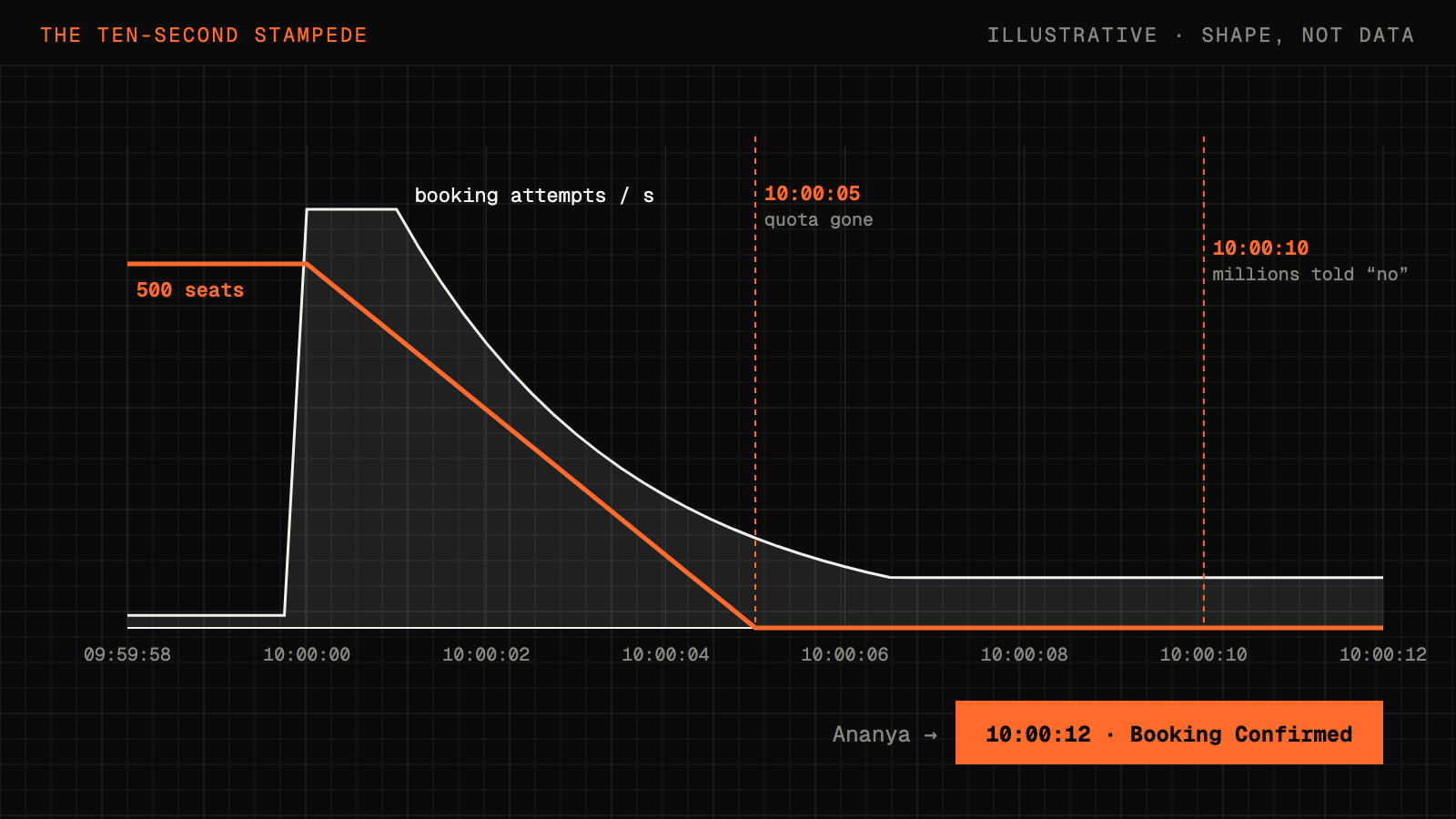
- 09:59:58Ananya's app is loaded. Her thumb is over the "Book Now" button.
- 09:59:59So are 1,999,999 other thumbs across the country.
- 10:00:00The clock ticks. Every single one of them presses at once.
- 10:00:01The system receives what feels like an instantaneous tidal wave — hundreds of thousands of requests in the same second, all demanding the same 500 rows of data.
- 10:00:05The popular train's Tatkal quota is already gone.
- 10:00:10Millions of "Sorry, no tickets available" messages have gone out.
- 10:00:12Ananya looks at her screen. It says "Booking Confirmed."
Indian Railways' actual, recorded numbers give a sense of scale here: the platform has clocked 37,410 tickets booked in a single minute at its all-time peak (August 2025), and routinely sees over 3 lakh (300,000+) concurrent users during the 10 AM Tatkal rush. Some estimates suggest that between 8 lakh and 1 million people attempt to even log in during that window, while only 3.3 to 3.5 lakh actually make it through.
Here's the counter-intuitive part, the thing that trips up most people the first time they think about this problem: this is not a storage problem. Five hundred confirmed bookings take up a few hundred kilobytes of disk space — genuinely nothing. The entire challenge is that, for about ten seconds, five hundred tiny rows of data become the single most contested resource in the country's digital infrastructure. The hard part isn't holding the information. It's surviving the stampede to get near it.
Why This Is Harder Than It Looks: The Microphone Problem#
Imagine a room with two million people, and in the middle of that room sits a single microphone with exactly 500 seconds of airtime left. Everyone wants to grab it, speak into it, and let go. Now imagine that the microphone itself has to somehow decide, fairly and instantly, who gets to hold it and for how long — while two million hands are grabbing at it simultaneously.
That's what a naive version of this system looks like. If you build it the "obvious" way — one database row for the seat count, updated every time someone tries to book — that single row becomes what engineers call a hot key: a piece of data so contested that it becomes the bottleneck for the entire system, not because the data is complicated, but because everyone wants to touch it at once.
The fix is surprisingly elegant once you see it: separate "can I even try?" from "give me the seat."
Picture a bouncer standing far outside the club, holding a small counter that starts at exactly 500. Every person who approaches gets one simple question answered — "is the counter still above zero?" — and the bouncer's counter ticks down by one for every "yes." This bouncer doesn't check IDs, doesn't collect payment, doesn't know anyone's name. All they do is one incredibly fast, incredibly simple job: say yes or no, instantly, to a firehose of people.
Only the roughly 500 people who get a "yes" ever reach the actual booking system inside — the one that checks passenger details, assigns a real berth, and takes payment. The other 1,999,500 people get told "no" by the bouncer, in milliseconds, without ever touching anything more delicate than a single number.
%% title: The bouncer and the booking system
flowchart TD
  P(["~2,000,000 people"]):::client --> BC["Bouncer · counter starts at 500"]:::hot
  BC --> B{"Still above zero?"}
  B -->|"yes · counter ticks down by one"| BK["Booking system<br/>passenger details · berth · payment"]:::core
  B -->|"no · in milliseconds"| N(["Told no<br/>1,999,500 people"]):::bad
  BK --> S(["~500 seats confirmed"]):::ok
This is the secret that makes the whole system survivable: the number of people you reject is unlimited, but the work of rejecting them must cost almost nothing.
The Virtual Waiting Room#
Even a fast bouncer gets trampled if two million people rush the door at the exact same instant. So there's a layer even before the bouncer: a virtual waiting room.
Here's how it actually feels from the user's side: the moment you try to book, instead of hanging on a spinning wheel, you're handed a queue ticket — something like "You are number 84,213. Estimated wait: a few seconds." You're not stuck; you're not lied to. You're told the truth, instantly, and then let through in a small, steady trickle that the booking system behind the scenes can actually handle.
What makes this waiting room smart, rather than just a glorified queue, is that it breathes with the system's real-time health:
- If the database is coping well, it opens the doors a little wider and admits people faster.
- The moment response times start climbing even slightly, it tightens the flow — automatically, within a second — long before anything actually breaks.
- It intentionally does not simply let in whoever clicked fastest. That would just reward whoever's script or connection is quickest, not whoever's need is most genuine — which matters a lot once you consider that some of those two million "people" aren't people at all (more on that shortly).
This single idea — a smart front door that adapts to the crowd, instead of a system that just gets crushed by it — is the difference between "IRCTC is down again" and "IRCTC handled it."
%% title: A waiting room that breathes
flowchart TD
  U(["Booking attempts at 10:00:00 AM"]):::client --> WR["Virtual waiting room<br/>You are number 84,213"]:::edge
  WR -->|"small, steady trickle"| BO{"Bouncer counter"}:::hot
  BO -->|"yes"| BK["Booking system"]:::core
  BK --> DB[("Database")]:::store
  DB -.->|"coping well · admit faster"| WR
  DB -.->|"response times climbing · tighten within a second"| WR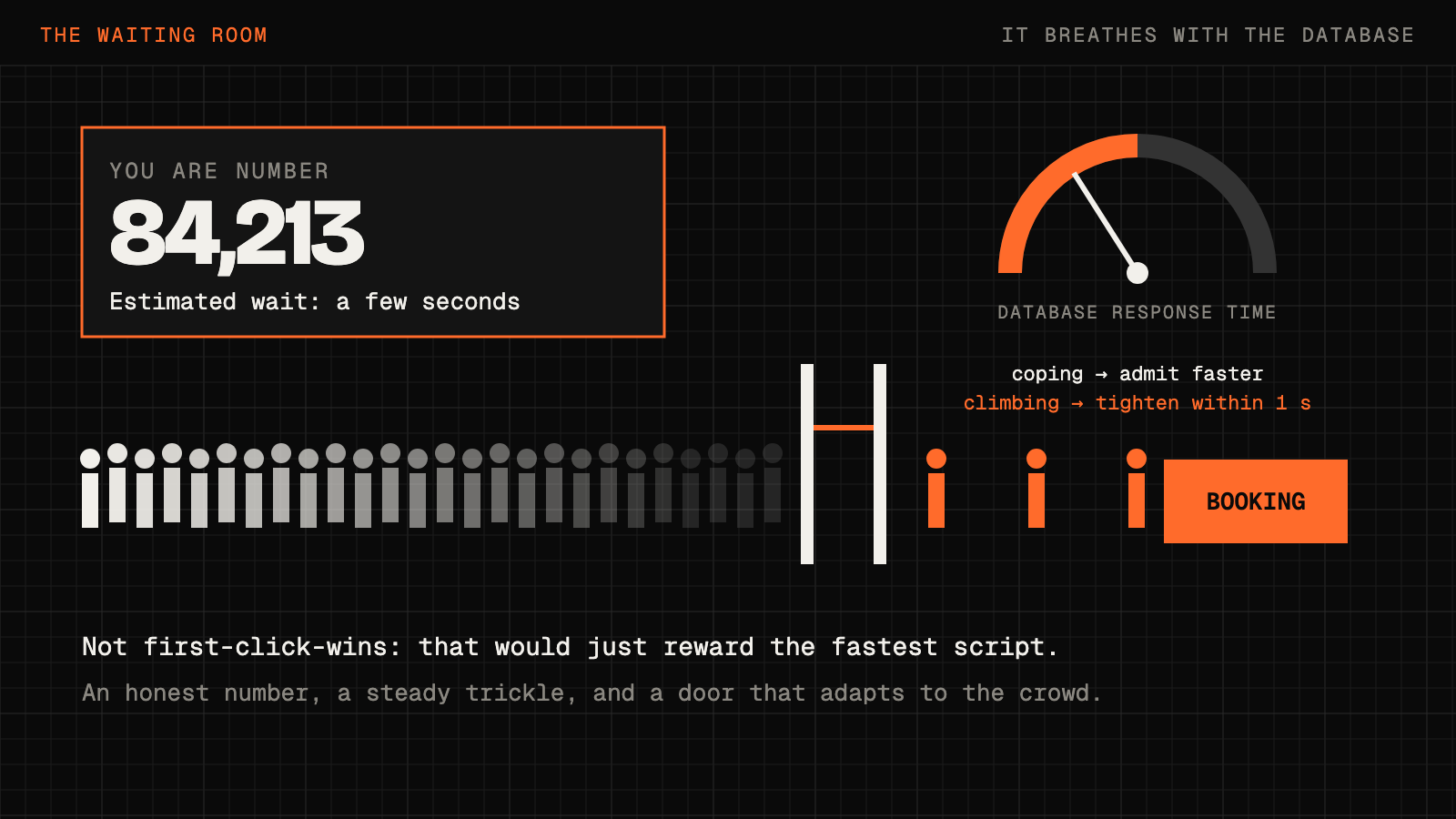
Hold First, Charge Later#
Say Ananya makes it through the waiting room and the bouncer says yes. She's not holding a ticket yet — she's holding a chance. She still has to pick her berth, type in passenger details, verify an OTP, and pay. That takes real time: seconds, sometimes a couple of minutes if her hands are shaking a little from the adrenaline.
During that window, the system does something clever: it puts a temporary hold on that one seat — invisible to everyone else, locked just for her, for exactly five minutes. If she completes payment in time, the hold becomes a real, permanent booking. If she gets distracted, her payment fails, or she simply takes too long, the hold automatically expires and the seat goes right back into the pool — instantly available to the next person in line.
This "hold, then confirm" pattern solves a problem you might not expect: what happens if her bank confirms the payment a few seconds after her hold has already expired? The system doesn't guess. It doesn't panic. It quietly flags that transaction for review, checks the real outcome with the payment provider, and resolves it cleanly — either the booking goes through after all, or, if the seat is truly gone, her money is automatically refunded, no support ticket required.
%% title: Hold, then confirm
stateDiagram-v2
  Held: Seat held · 5 minutes
  Confirmed: Permanent booking
  Expired: Hold expired · seat back in the pool
  Flagged: Late payment flagged for review
  Refunded: Automatically refunded
  [*] --> Held: bouncer says yes
  Held --> Confirmed: payment completes in time
  Held --> Expired: distracted · payment fails · too slow
  Expired --> Flagged: bank confirms a few seconds late
  Flagged --> Confirmed: provider confirms · seat still free
  Flagged --> Refunded: seat truly gone
  Confirmed --> [*]
  Refunded --> [*]
  class Held core
  class Confirmed ok
  class Expired bad
  class Flagged queue
  class Refunded service
That last part matters more than it sounds. In a system moving this fast, the one rule that can never, ever bend is: money and seats must always match up, exactly, for every single person, every single time.
The War Against Bots#
Here's the part of this story that isn't really about engineering at all — it's about human (and inhuman) behavior.
Every seat a script grabs in the opening seconds is a seat a real, urgent traveler never gets to see. And for years, that's exactly what happened at scale: automated scripts that fill forms faster than any human, and organized touts who'd snap up Tatkal seats in bulk within seconds to resell them at a markup — a genuinely illegal practice in India, and a deeply frustrating one for ordinary passengers.
The 2025 numbers on this are staggering. Indian Railways disclosed that it deactivated about 3.03 crore (30.3 million) suspicious user accounts, put crores more under suspension or revalidation that year, blocked nearly 13,000 suspicious email domains, and reported around 4 lakh (400,000) suspicious PNRs on the National Cyber Crime Reporting Portal. This isn't a hypothetical threat model — it's a daily, industrial-scale fight.
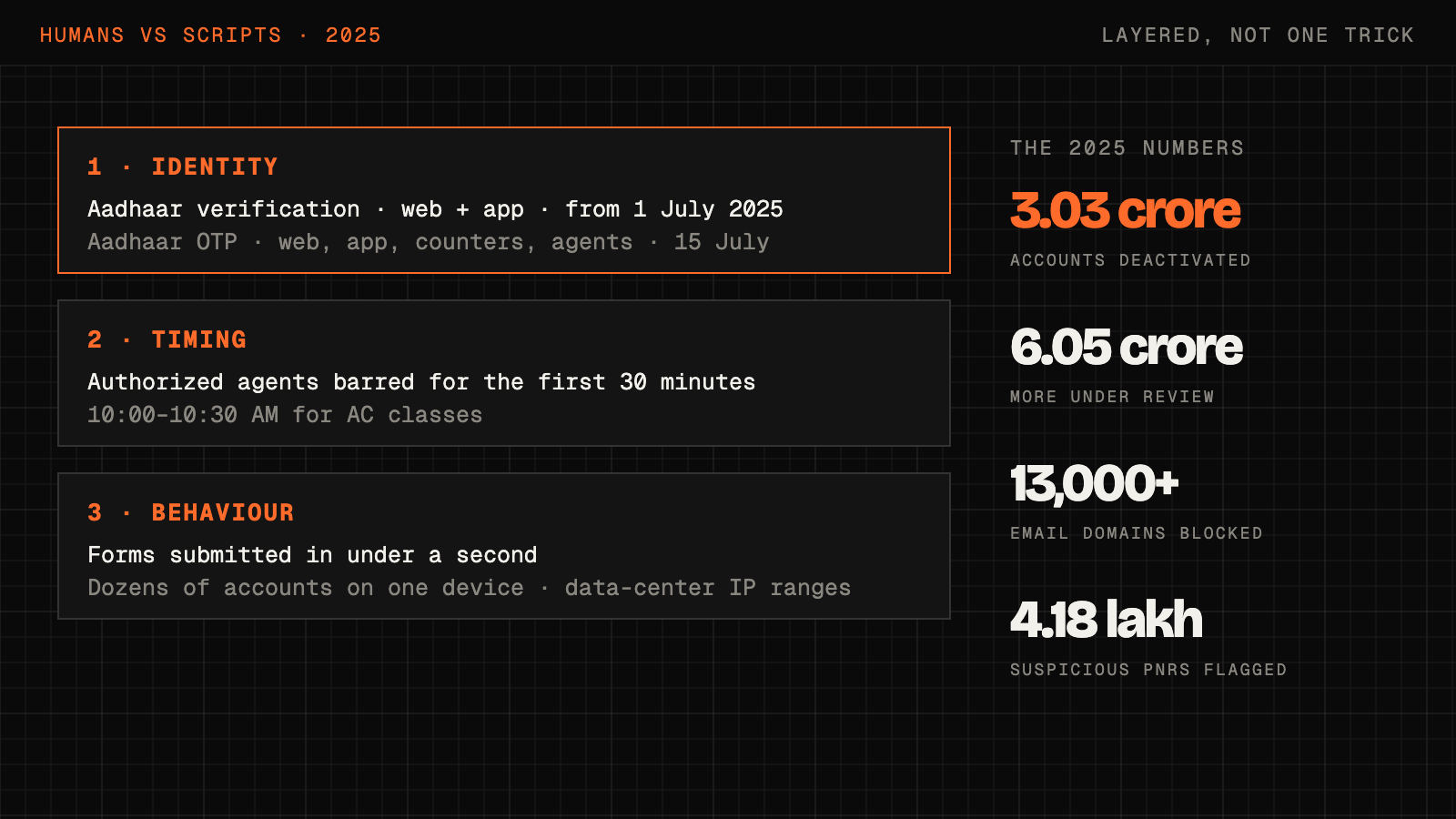
The response, rolled out through 2025, reads like a layered defense:
- Aadhaar-based identity verification became mandatory for Tatkal bookings on the website and app starting 1 July 2025.
- Aadhaar-linked OTP authentication became mandatory — for web, app, and counter/agent bookings — from 15 July 2025.
- Authorized travel agents were banned from booking in the first 30 minutes of the Tatkal window (10:00–10:30 AM for AC classes), specifically to give individual travelers a fair shot at the seats that matter most: the very first ones released.
- Behind the scenes, the system watches for tells that no human typing on a phone would produce: forms submitted in under a second, dozens of "different" accounts all logging in from the same device, requests pouring in from data-center IP ranges rather than actual homes or mobile networks.
None of these are silver bullets on their own. Together, they raise the cost of cheating high enough that most of it simply isn't worth attempting anymore — which, in security, is often the most realistic version of "winning."
When It All Goes Wrong: Real War Stories#
No system this contested gets everything right on the first try, and IRCTC's own history proves it.
December 2024, a Tatkal morning like any other: complaints started flooding social media and outage-tracking sites around 10 AM, right as the Tatkal window opened. Users trying to book were met with a message that must rank among the most painful sentences in Indian tech: "Due to maintenance activity, e-ticketing service will not be available for the next one hour. Please try later." On a Tatkal morning, "try later" isn't advice — it's a door slamming shut on someone's train.
October 2025, in the run-up to Diwali and Chhath Puja — the biggest travel season of the year — server errors returned during the Tatkal window yet again (17 October), echoing the string of December 2024 failures. Passengers, understandably, asked the obvious question: why does this keep happening during the exact minutes when it matters most?
The recurring lesson across these incidents is almost always the same one: when the system that lets people check availability shares infrastructure with the system that lets people book, a spike in one drags down the other. A curious person refreshing the availability page a hundred times shouldn't be able to make a real booking attempt any slower — but if both are running on the same overloaded servers, that's exactly what happens.
%% title: When looking and buying share servers
flowchart TD
  C(["Curious person<br/>refreshing a hundred times"]):::client --> AV["Checking availability<br/>~4,00,000 enquiries/minute capacity"]:::service
  R(["Real booking attempt"]):::client --> BK["Actually booking<br/>~32,000 tickets/minute capacity"]:::core
  AV --> SH["Same overloaded servers"]:::bad
  BK --> SH
  SH -->|"a spike in one drags down the other"| SL(["Booking attempts slower<br/>server errors in the Tatkal window"]):::bad
It's a humbling reminder that even a platform processing over a million tickets a day, with genuinely sophisticated engineering behind it, is still fighting an ongoing battle against its own popularity — and against a clock that refuses to give it any warm-up time.
Lessons for Any Engineer#
You don't need to work on a national railway system to run into a smaller version of this problem. Flash sales, concert ticket drops, exam registration portals, government subsidy schemes with limited slots — they're all the same shape: too many people, too little inventory, too short a window.
A few things this story makes clear, regardless of what you're building:
- Storage is rarely your bottleneck in a rush like this — traffic shape is. Five hundred rows of data were never the hard part; surviving the stampede to reach them was.
- Separate the "looking" traffic from the "buying" traffic, physically if you can. They have completely different tolerances for staleness and completely different consequences for failure.
- Reject fast, reject cheap, and reject honestly. A system that can instantly say "you're #84,213, here's your honest wait" builds more trust than one that hangs silently and times out.
- "Hold, then confirm" beats "grab and hope" for anything involving both inventory and payment — always give yourself a clean, automatic way to undo a half-finished transaction.
- Assume some of your traffic isn't human, and design your defenses in layers — identity, timing, and behavior — rather than betting everything on one clever trick.
Summary: The Ten Seconds That Matter Most#
Ananya's booking confirmation arrives at 10:00:12 AM. Twelve seconds. Somewhere in a data center, a small in-memory counter ticked down from 500 to 499, and stayed honest through a wave of two million simultaneous requests that could easily have broken it.
She books her seat home to see her grandmother. A few hundred kilometers away, someone else refreshes their screen one more time, sees "Sold Out," and starts looking at the waitlist instead — disappointed, but not double-charged, not stuck in limbo, not lied to about what happened.
That, in the end, is the real achievement here. Not that the system is unbreakable — history shows it isn't, not always. But that on most days, for most people, in a country of over a billion, a system built to handle an almost absurd amount of simultaneous hope manages to say "yes" to exactly the right five hundred people, and an honest, instant "no" to everyone else.
The next time you're refreshing a page at exactly 10:00:00 AM, hoping to be one of the lucky few — somewhere behind that spinning loader, a very small, very fast counter is quietly doing the hardest job in the building.
Have you ever been one of the lucky few in a Tatkal rush — or one of the millions who weren't? The system behind that ten-second window is a small masterpiece of engineering under pressure, built one hard lesson at a time.
Read it through to close the case.
0/10 sections read. Each one counts after a few minutes of actual reading in it; skipping ahead doesn't. The case closes itself once every section is read.
All case files →Ananya's payment clears 4 seconds after her 5-minute seat hold expired. What should the system do?
Rush control room
It's 9:59:59 and you run the door. Pick the architecture that survives the 10:00:00 stampede, then sort eight sessions into humans and bots using IRCTC's 2025 rules.
- ~3 MIN
- 3 STEPS · 11 PTS
- SOLVE AT 8/11
- +25 XP
Discussion